
COPYRIGHTED SPENDTHRIFT TRUST
- A Settlor has no rights or beneficial interest in the Trust.
- The Compliance Overseer can be the trustee (as long as he/she is not the Settlor of the trust). The Compliance Overseer can appoint another party to be the trustee; however, the Compliance Overseer can still replace the trustee that he/she has appointed.
- The Compliance Overseer can appoint or remove any beneficiary at will. A Compliance Overseer may never be a beneficiary.
- Beneficiaries in a Spendthrift Trust may be anyone or any organization named in the Trust Documents.
- The Compliance Overseer can appoint his/her successor at any time during his lifetime.
- The trustee may disburse funds to the beneficiaries in equal amounts, unequal amounts or not at all at his/her absolute discretion.
- If a Compliance Overseer does not appoint a successor, then upon his/her death, the office disappears. Yet, the existing appointed trustee and the beneficiaries remain the same.
- When the Settlor or anyone else gives money or assets to the trust for it to be capitalized or endowed, no taxable event has occurred. The trust pays taxes only on what the assets earns unless deemed to be paid to the corpus according to the terms and conditions of the trust, which is discretionary.
- Any monies that the trustee distributes from the original endowment of the trust to the beneficiaries are a nontaxable event for the trust. The monies that the trust earns are taxable unless deemed to be paid to the corpus according to the terms and conditions of the trust.
- Once the assets are placed into the trust, no court or entity can remove them. Spendthrift Trusts have proven to withstand court judgments, divorces, bankruptcies and lawsuits. These trusts have been successful in preventing creditors from attaching trust assets.
- Trusts can own and trade government securities, stocks, and bonds, gold precious metals or any other form of asset. The trust can hold, buy or sell real estate.
- The monies that are paid to the beneficiaries are a taxable event to the beneficiary from the endowment funds of the trust according to their income level if earned income is the distribution; only the monies that a trust earns from the endowment and are undistributed to the beneficiaries are taxable to the trust if retained by the trust unless deemed to be paid to the corpus according to the terms and conditions of the trust. Master’s Trust Format is a discretionary trust and complies with this IRS regulation.
- Trusts are required to file federal income tax returns. Form 1041 is used. However, a Spendthrift Trust is a complex trust and the capitalizations or endowments of the trust are not taxable events and deemed to be paid to the corpus according to the terms and conditions of the trust. Capitalizations or Endowments are retained indefinitely and only distributed by the trustees of the trust to the beneficiaries at the sole and absolute discretion of the trustees only. All capitalizations or endowments of a trust that are retained in the corpus are not a taxable event.
MAIN ADVANTAGES OF THE SPENDTHRIFT TRUST
- Every aspect of it is lawful. It is guaranteed by the U.S. Constitution, Supreme Court and other court decisions.
- It is easy to establish, can be maintained by you and involves minimal paperwork. It greatly reduces or eliminates fees.
- It is lawful in every state. A Spendthrift Trust properly established in one state can operate in any other state.
- It is made irrevocable to avoid any questions as to ownership of the assets.
- It prevents any information about your assets, liabilities and heirs from becoming public.
- It can operate any lawful business anywhere in the world. It has limited liability and most of the advantages of a corporation with none of the disadvantages.
- It has no periodic reports or accounting to make to any state or government.
- It has the same constitutional rights as any individual, that is, the right to privacy, freedom from unwarranted search and seizure, to refrain from self-incrimination and all other rights.
- When the Spendthrift Trust is used in a legal manner and under the provisions of the Spendthrift, it is totally impenetrable by creditors, agencies, governments and is immune from transfer by operation of law.
- Your personal bankruptcy has no effect on the Spendthrift Trust assets.
Interesting Facts
A contract in the form of a Spendthrift Trust Organization, does not owe its existence to any act of the legislature. The authority for its creation is the common law right of the parties to enter into a contract which the Constitution recognizes. According to American law, the government cannot regulate or impose a tax upon a right. Our “right to contract” according to the Constitution of the United States, Article. §10 is unimpariable.
That means that it is not within the power of the government or even a judge to change one word of a Contract of Trust. Once the property is transferred into a Spendthrift Trust Organization, it is subject to its own indenture, which governs and, protects the property held by it. The government can ONLY regulate and tax entities it creates.
A Spendthrift Trust Organization has the income tax requirement to pay only the tax on the income money that the corpus or endowments of the trust earns unless deemed to be paid to the corpus according to the terms and conditions of the trust. If set up properly, all capitalizations or endowments of the trust are nontaxable. Like corporations, Revocable Living Trusts are statutory and are subject to legislative control and taxation. A Revocable Living Trust is required to file a 1041 Form each year. While the income in a corporation is taxable and the endowments to a Revocable Living Trust are taxable, capitalizations or endowments to a Spendthrift Trust are not.
In Weeks v. Sibley DC 269£, 155, Edwards V. Commissioner. 41512£!, 532 10th Cir. (1969) and Philips v. Blanchard 37 Mass 510, the courts ruled thata Spendthrift Trust Organization is not illegal even if formed for the express purpose of reducing or deferring taxes Edison California Stores, Inc. v McColgan. 30 Cal 26472.183 P2d 16. ruled that persons may adopt anylawful means for the lessening of the burden of income taxes;The Department of the Treasury, IRS Handbook for Special Agents § 412, Tax Avoidance Distinguished from Evasion states; “Avoidance of Taxes isnot a criminal offence. Any attempt to reduce, avoid, minimize, or alleviate taxes by legitimate means is permissible”.
Pursuant to Narragansett Mut. F. Ins. Co. v. Burnhamun 51 r1371, 154 a 909, It is not an evasion of legal responsibility to take what advantage may accrue from the choice of any particular form of organization permitted by law.
A Spendthrift Trust is not considered a taxable “Association” pursuant to tax law. Black’s Law Dictionary defines Association as follows: “What is designated as a trust or a partnership may be classified as an association [only] if it clearly possesses [all] corporate attributes. Corporate attributes include: [1] centralized management, [2] continuity of existence, [3] free transferability of interest, [4] limited liability.
A Spendthrift Trust Organization is not an “association” or an “unincorporated association,” because it does not possess the same attributes of a corporation, such as continuity of existence and free transferability of [beneficial] interest. Further, unlike a corporation, a Spendthrift Trust Organization is not an “artificial entity” nor does it owe its existence to the charter power of the State.
A Spendthrift Trust Organization is also not an alter ego or a nominee for any trustee or beneficiary because no one individual holds both legal and equitable title and beneficial interest.
Another major advantage to operating a Spendthrift Trust Organization as a business is that, because it is not a creature of the legislature, it is not subject to the myriad of strangling legislative controls, rules and regulations that are applicable to corporations and other legislative entities. The Supreme Court case Eliot v. Freeman 220 US 178 ruled that a Spendthrift Trust Organization is not subject to legislative control. The Supreme Court holds that the trust relationship comes under the realm of equity based on common law and is not subject to legislative restrictions as are corporations and other organizations created by legislative authority.

Legal Facts
- A Spendthrift Trust Organization has the income tax requirement to pay only the tax on the income money that the corpus or endowments of the trust earns unless deemed to be paid to the corpus according to the terms and conditions of the trust. If set up properly, all capitalizations or endowments of the trust are nontaxable. Like corporations, Revocable Living Trusts are statutory and are subject to legislative control and taxation. A Revocable Living Trust is required to file a 1041 Form each year. While the income in a corporation is taxable and the endowments to a Revocable Living Trust are taxable, capitalizations or endowments to a Spendthrift Trust are not.
- In Weeks v. Sibley DC 269£, 155, Edwards V. Commissioner. 41512£!, 532 10th Cir. (1969) and Philips v. Blanchard 37 Mass 510, the courts ruled that a Spendthrift Trust Organization is not illegal even if formed for the express purpose of reducing or deferring taxes Edison California Stores, Inc. v McColgan. 30 Cal 26472.183 P2d 16. ruled that persons may adopt any lawful means for the lessening of the burden of income taxes; The Department of the Treasury, IRS Handbook for Special Agents § 412, Tax Avoidance Distinguished from Evasion states; “Avoidance of Taxes is not a criminal offence. Any attempt to reduce, avoid, minimize, or alleviate taxes by legitimate means is permissible”.
- A Spendthrift Trust is not considered a taxable "Association" pursuant to tax law. Black's Law Dictionary defines Association as follows: "What is designated as a trust or a partnership may be classified as an association [only] if it clearly possesses [all] corporate attributes. Corporate attributes include: [1] centralized management, [2] continuity of existence, [3] free transferability of interest, [4] limited liability. A Spendthrift Trust Organization is not an "association" or an “unincorporated association," because it does not possess the same attributes of a corporation, such as continuity of existence and free transferability of [beneficial] interest. Further, unlike a corporation, a Spendthrift Trust Organization is not an "artificial entity" nor does it owe its existence to the charter power of the State. A Spendthrift Trust Organization is also not an alter ego or a nominee for any trustee or beneficiary because no one individual holds both legal and equitable title and beneficial interest.
Another major advantage to operating a Spendthrift Trust Organization as a business is that, because it is not a creature of the legislature, it is not subject to the myriad of strangling legislative controls, rules and regulations that are applicable to corporations and other legislative entities. The Supreme Court case Eliot v. Freeman 220 US 178 ruled that a Spendthrift Trust Organization is not subject to legislative control. The Supreme Court holds that the trust relationship comes under the realm of equity based on common law and is not subject to legislative restrictions as are corporations and other organizations created by legislative authority.
- Pursuant to Narragansett Mut. F. Ins. Co. v. Burnhamun 51 r1371, 154 a 909, It is not an evasion of legal responsibility to take what advantage may accrue from the choice of any particular form of organization permitted by law.
Downloads
Case Law Downloads
Click the button below to download Case Law.
Click the button below to download Trust Private Letter Ruling.
Trust Report Downloads
SPECIALIZED INSURANCE ASSET TRUST (SIAT)
TRUST VS. 1031 EXCHANGES
IRS CODE & LEGAL COMPLIANCE
BASIC TRUST EXECUTIVE SUMMARY
CHARITABLE TRUST VS. FOUNDATIONS
TRUST VS. COMMON LAW (MODERN COMPLIANT TRUSTS)
EXAMPLES OF TRUST EXPENSES
Bill of Sale/Demand Notes/Leases/PSAs
Bill of Sale
The Bill of Sale is a document that is used to sell/transfer ownership of assets from one person/entity (e.g., revocable trust, LLC, S-Corp, C-Corp) to a trust. The seller does not necessarily have to be you, anyone can sell assets to your trust. A list of all assets should be created and attached to the Bill of Sale. This list will be called “Exhibit A”. This document requires notarized signatures and should be kept in your trust book.
Equipment Lease Agreement
The Equipment Lease Agreement for business equipment is used by companies when they have transferred/sold their assets from their business to their beneficial trust, and subsequently need to lease the assets back to the business for a monthly lease amount.
Vehicle Trust Registration
The Motor Vehicle Trust Registration document is a form that is used to transfer a vehicle(s) from the seller to the trust. It does not necessarily have to be filed with your local DMV. However, if it is convenient to file, then please do so. This document requires notarized signatures and should be kept in your trust book.
Commercial Property Lease Agreement
The Commercial Property Lease Agreement is used when real property has been transferred to the trust, and subsequently needs to be leased back to a business for a monthly lease amount.
Demand Note
The Demand Note is a return of capital, a note payable from the trust with no fixed term or repayment schedule. The Demand Note is used to take money from the trust tax free and is normally taken for expenses that the trust won’t cover (clothing, vacation, etc.). Every time that money is taken from the trust for things that the trust won’t cover, it will reduce your demand note. This document requires notarized signatures and should be kept in your trust book.
Intellectual Property Lease Agreement
The Intellectual Property Lease Agreement is for individuals who have tangible and intangible intellectual property that have been transferred to the trust, such as copyrights, trademarks, websites, marketing plans, etc. These tangible and intangible intellectual property assets can also be leased back for a monthly lease amount.
The Internal Revenue Code States
Internal Revenue TITLE 26, Subtitle A, CHAPTER 1, Subchapter J, PART I, Subpart A, Sec 643 (a)(3),(4),(7) and (b) states:
“(3) Capital gains and losses. Gains from the sale or exchange of capital assets shall be excluded to the extent that such gains are allocated to corpus and are not (A) paid, credited, or required to be distributed to any beneficiary during the taxable year, or (B) paid, permanently set aside, or to be used for the purposes specified in section 642 (C). Losses from the sale or exchange of capital assets shall be excluded, except to the extent such losses are taken into account in determining the amount of gains from the sale or exchange of capital assets which are paid, credited, or required to be distributed to any beneficiary during the taxable year. The exclusion under section 1202 shall not be taken into account.
(4) Extraordinary dividends and taxable stock dividends For purposes only of subpart B (relating to trusts which distribute current income only), there shall be excluded those items of gross income constituting extraordinary dividends or taxable stock dividends which the fiduciary, acting in good faith, does not pay or credit to any beneficiary by reason of his determination that such dividends are allocable to corpus under the terms of the governing instrument and applicable local law.
(7) Abusive transactions The Secretary shall prescribe such regulations as may be necessary or appropriate to carry out the purposes of this part, including regulations to prevent avoidance of such purposes. If the estate or trust is allowed a deduction under section 642(c), the amount of the modifications specified in paragraphs
(5) and (6) shall be reduced to the extent that the amount of income which is paid, permanently set aside, or to be used for the purposes specified in section 642(c) is deemed to consist of items specified in those paragraphs. For this purpose, such amount shall (in the absence of specific provisions in the governing instrument) be deemed to consist of the same proportion of each class of items of income of the estate or trust as the total of each class bears to the total of all classes. (b) Income for purposes of this subpart and subparts B, C, and D, the term "income", when not preceded by the words "taxable", "distributable net", "undistributed net", or "gross", means the amount of income of the estate or trust for the taxable year determined under the terms of the governing instrument and applicable local law.
Items of gross income constituting extraordinary dividends or taxable stock dividends which the fiduciary, acting in good faith, determines to be allocable to corpus under the terms of the governing instrument and applicable local law shall not be considered income.
NON-GRANTOR IRREVOCABLE SPENDTHRIFT TRUST
This trust is are designed for those who have the most to protect, either now or in the future, and the susceptibility to liability that goes along with their success.
Once the assets are placed into the trust, no court or entity can remove them. Spendthrift Trusts have proven to withstand court judgments, divorces, bankruptcies and lawsuits. These trusts have been successful in preventing creditors from attaching trust assets.
Trusts can own and trade government securities, stocks, and bonds, gold precious metals or any other form of asset. The trust can hold, buy or sell real estate.
The best time for estate planning and asset protection is NOW, before a crisis overtakes you.
WHO CAN BENEFIT: EVERYONE!
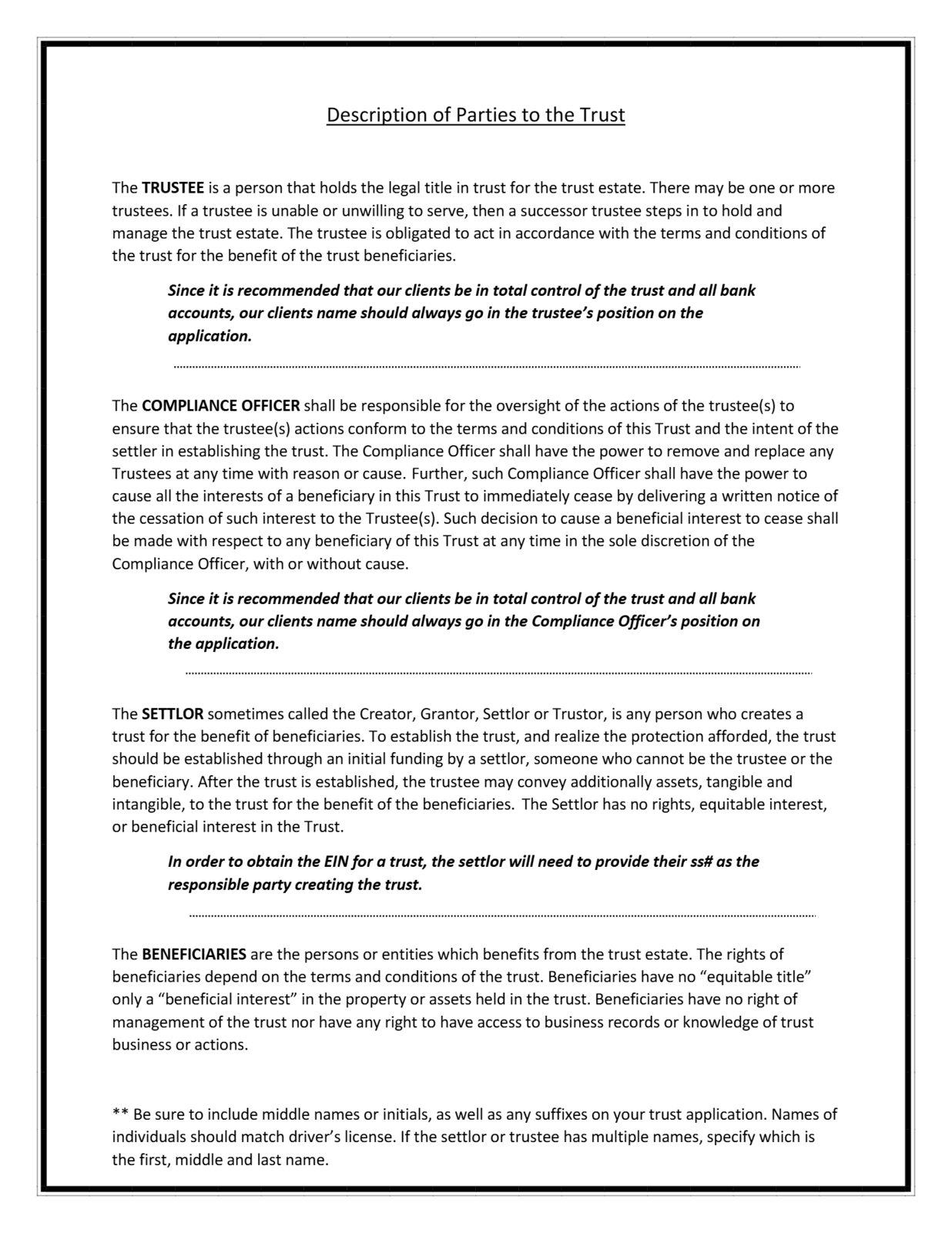
Description of Parties to the trust
Benson Financial LLC - COPYRIGHTED